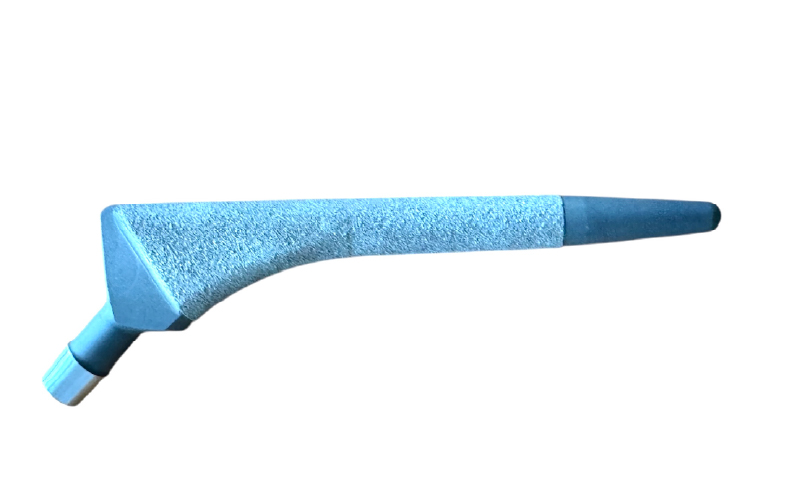
Demographic ageing represents one of the greatest challenges currently facing medicine, particularly in the field of orthopaedics. The growing need for surgical interventions in elderly individuals exposes significant limitations of conventional bone implants, especially with regard to their integration into ageing bone tissue. As Eduardo Ascenso Pires, CEO of CERAMED, explains, “RESET_Bone_Ageing_2 is a project led by CERAMED, with the participation of the Therapies group at the Faculty of Medicine of the University of Coimbra (FMUC) and the Animal Bioscience group at the University of Évora’, born out of the clear identification of ‘a relevant problem in the field of medical devices for bone application”.
The growth of orthopaedics and the limitations of ageing bone
In recent decades, the use of medical devices in orthopaedics has become common practice. According to the head of the operation, “in the last five decades, the use of medical devices in orthopaedics has increased significantly, becoming common practice in medicine”. This reality is accompanied by strong market growth: “in 2022, the global market for orthopaedic implants was valued at $48 billion and is estimated to reach around $72.08 billion by 2032, with a compound annual growth rate (CAGR) of 4.2% between 2023 and 2032”.
However, this growth brings with it significant clinical challenges. ‘A large number of individuals over the age of 65 undergo total joint replacement surgery’ and, particularly worryingly, “of these, around 40% have osteopenia, i.e. low bone density’. This condition seriously compromises the success of implants, as it ‘limits the effective integration of the implant into the bone tissue, increasing the risk of fractures.”
A customised implant with an anti-ageing approach
It is in this context that the RESET_Bone_Ageing_2 operation, promoted by CERAMED and co-financed by COMPETE 2030, comes into play. The project aims to develop a customised implant — an intramedullary nail — with a bone-integrating and anti-ageing biological coating, produced according to GMP (Good Manufacturing Practices) specifications. According to Eduardo Pires, “the RESET_Bone_Ageing_2 project aims to develop, for the first time, a biological coating capable of promoting faster and more effective integration of the implant into aged bone.”
This innovative coating is based on the use of Extracellular Vesicles with specific biological properties, capable of modulating the cellular response of ageing bone. The ambition goes beyond the simple mechanical integration of the implant, seeking to actively intervene in the underlying biological processes.
Rejuvenating the bone interface
One of the most disruptive concepts of RESET_Bone_Ageing_2 lies in inducing a local rejuvenation process. As the CEO of CERAMED points out, “to this end, the coating will induce a rejuvenation process at the bone tissue interface”. This approach aims to reduce cellular senescence phenomena, i.e. the state in which aged cells lose their ability to regenerate and respond effectively to biological stimuli, creating more favourable conditions for osseointegration and long-term implant stability.
The project also includes the lyophilisation and packaging of the biological coating, i.e. a cold drying process that preserves the biological properties of the material, enabling its direct use in a surgical context without significant loss of bioactivity, bringing scientific research closer to clinical reality.
Pre-clinical validation and prospects for clinical application
The robustness of RESET_Bone_Ageing_2 is also based on its pre-clinical validation. ‘The potential of this coating will be tested on aged sheep,’ a medium-sized animal model that allows for rigorous evaluation of the local and systemic response to the implant. The ultimate goal is clear: “at the end of the project, to make a new innovative product available for clinical application.”
A project with an impact on the future of health
By combining personalisation, biotechnology and an active approach to bone ageing, RESET_Bone_Ageing_2 stands out as a decisive step in the evolution of orthopaedic medical devices. The operation reinforces CERAMED’s role as an agent of innovation in the field of healthcare and demonstrates how collaboration between industry and the scientific system can generate solutions with a high clinical, economic and social impact.
An innovative approach that transforms grape waste into sustainable cosmetic ingredients, boosting competitiveness and scientific expertise within the Portuguese industry.
A new technological approach is transforming wastewater treatment plants into resource recovery facilities, combining nutrient recovery with the removal of micropollutants to pave the way for a more sustainable future in the water sector.
The POLECAT project explores new technological solutions for integrating electronics into automotive components, promoting innovation and sustainability.